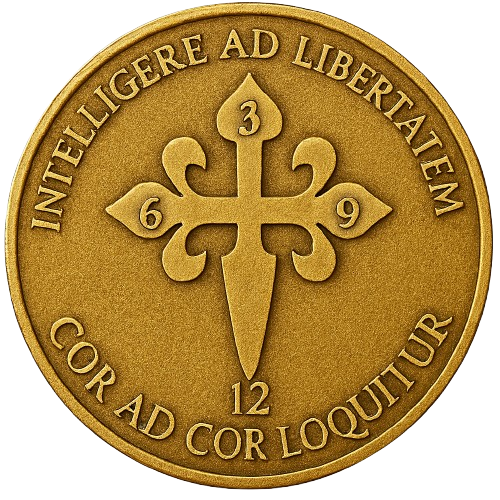

This emblem is not a mere graphic mark, but a threshold.
Each element that composes it — the cross, the numbers, the inscriptions — speaks not only to the eye, but to thought, to memory, to vocation. It is a contemplative seal and a symbolic orientation, a visual synthesis of what your project seeks to guard and transmit.
At the centre stands the stylised cross, its arms ending in the fleur‑de‑lis, the lily — a symbol of the soul’s purity. It is a perennial flower, emblem of rebirth and spiritual regeneration. The Cross becomes the sign of the inner pilgrimage: the emptying of the psychological self, the elevation of the soul through spiritual combat, fidelity to the way, and Christian apatheia within the world. The four directions — 3, 6, 9, 12 — are not mere numbers: they are mystical coordinates, interior rhythms, sacred figures that recall Christian numerology and the structure of redeemed time.
3: the Trinity — perfection that does not close but opens; unity that gives itself in communion.
6: the day of humankind — creation completed yet not transfigured; the threshold between the earthly and its fulfilment.
9: the number of spiritual completion, maturity, and manifest grace; the ninth hour of the Passion, where all is accomplished.
12: fullness — the tribes, the apostles, the heavenly Jerusalem; the number that unites history and eschatology, earth and heaven.
Placed in the form of a cross, these numbers do not construct a system, but an orientation: they indicate that freedom lies beyond human arbitrariness, as a spiritual measure of communion with God; it is neither will nor dispersion, but vocation. The cross thus becomes a spiritual compass, an interior map, an invitation to intelligere — to understand — in order to liberate.
Above the cross, the inscription “Intelligere ad libertatem” is the guiding principle.
It is not a slogan, but a contemplative formula: to understand in order to liberate, to liberate in order to serve. Freedom is not a product of the State, but a gift of the Eternal. It is pre‑political, pre‑juridical, pre‑discursive. It belongs to the deepest structure of the human being, and any thought that betrays it distances itself from truth.
Beneath the cross, “Cor ad cor loquitur” — the heart speaks to the heart — is the mystical signature of the project.
It is not communication, but transmission. The heart does not argue: it resonates, recognises, opens. This phrase, attributed to Saint John Henry Newman, indicates that truth does not impose itself, but reveals itself; it is not conquered, but received. It is the principle of mysticism: the recognition and coexistence with the Mystery.
The logo, as a whole, is a symbolic architecture:
-
the cross as orientation;
-
the numbers as rhythm;
-
the inscriptions as vocation;
-
the gold as a sign of dignity, light, transfiguration.
It is not a brand, but a seal.
It does not represent an identity, but guards it.
It does not impose a vision, but opens it.
In this sense, the logo is already thought, already pilgrimage, already invitation.
It is the point from which to depart and the point to which to return.
It is the visible form of an intelligence that seeks freedom not as possession, but as task.