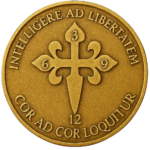

My name is Alessandro Gianmoena, and my path is rooted in a conviction that precedes every form of belonging: freedom is not a product of history, but its source. It is a gift, a vocation, a responsibility. Everything I have done — writing, contributing to formation, communicating and interpreting — is grounded in this orientation.
My political and spiritual formation was shaped alongside don Gianni Baget Bozzo, a priest, mystic and political thinker among the most original of late twentieth‑century Italy, as well as adviser to Silvio Berlusconi, a statesman and entrepreneur who marked an entire season of the Italian Republic, reshaping its political landscape and serving several terms as President of the Council of Ministers. Baget Bozzo was, above all, a master capable of showing that politics, when authentic, is a spiritual act before it is a strategic one.
With him, I crossed the frontier where theology, politics and destiny converge. I served as his political secretary and, together with him, devoted many years to political formation, in a time when politics had not yet been reduced to technique but still preserved a vocational dimension.
My journey unfolded within a decisive historical transition: the end of the twentieth century, the dissolution of the great utopias, the decline of modernity and the emergence of postmodernity. After the fall of the Berlin Wall, globalisation — a natural expression of human interaction — was also presented in ideological form, as a project of turbo‑capitalism in which finance overshadowed the economy and financial power tended to dominate nations. In some of its more extreme drifts, this imaginary approached the idea of a single world government, capable of homogenising cultures and religions, imposing consumerist models and transhumanist visions of a human being who imagines himself the creator of his own nature.
It was a world that risked turning the future into an eternal present governed by machines, founded solely on material needs. A dystopia mirroring the utopias of the twentieth century: both united by the same abstraction that seeks to bend reality, both unable to recognise the dignity of peoples, reduced to mass, to function, to instrument.
In such a scenario, the only remedy against every form of servitude remains human freedom: not merely economic, not merely political, but spiritual. This is the fire that has sustained my cultural motivation and my civic commitment; it is the force that led me to work alongside Baget Bozzo until his passing, within the political project of freedom inaugurated by Silvio Berlusconi in 1994.
In the early 2000s, together with Baget Bozzo, I founded Ragionpolitica, one of the first Italian political‑cultural journals born on the internet: a pioneering laboratory where analysis, genealogy and vision intertwined to read the present without submitting to it. That experience shaped my method: to think as an act of freedom, to interpret as service, to write as responsibility.
Today my work continues along that same line: weaving geopolitics, culture, mysticism and philosophy into a single fabric capable of speaking to both heart and intellect. Intelligere ad libertatem is the name of this path: to understand in order to liberate, to liberate in order to serve.
The rest — what truly matters — takes place in the inner movement of the reader. For freedom is not possessed: it is guarded. And transmitted.